Monotheism: One God, recognized as the Creator.
God is omnipotent, omniscient, immanent within His creation yet transcendent.
At the end of the world, God will judge humans based on their actions in compliance with a moral code, specified in the Covenant which God makes with us.
This judgment will determine one's eternal abode, heaven or hell
Human beings have a soul which is eternal, continuing its existence after our physical death
Humans have the ability (free will) to choose between good and evil
Angels exist who are the servants, and sometimes messengers of God
Satan exists, as well as evil spirits who follow him; they are the enemies of humanity
Miracles occur on occasion.
If a person errs or transgresses, God may forgive them, if they sincerely repent.
Prophets brought spiritual instruction.
Jesus Christ was born to the virgin Mary.
At the time of the end of the world, Jesus Christ will come again.
Prayer is a means of communicating with God; God hears prayers and sometimes grants requests.
Charity and relieving the suffering of others carries spiritual rewards.
Certain standard prayers exist.
Wednesday, November 18, 2009
Striking Similarites: Christianity and Islam

Wednesday, November 11, 2009
First Council of Nicaea
An important outcome of this event was the first agreed upon doctrine of Christianity. It is known as the Nicene Creed and was stated as follows:
And in one Lord Jesus Christ, the Son of God, begotten of the Father [the only-begotten; that is, of the essence of the Father, God of God], Light of Light, very God of very God, begotten, not made, being of one substance (ὁμοούσιον) with the Father; by whom all things were made [both in heaven and on earth]; who for us men, and for our salvation, came down and was incarnate and was made man; he suffered, and the third day he rose again, ascended into heaven; from thence he shall come to judge the quick and the dead.
And in the Holy Ghost.
[But those who say: 'There was a time when he was not;' and 'He was not before he was made;' and 'He was made out of nothing,' or 'He is of another substance' or 'essence,' or 'The Son of God is created,' or 'changeable,' or 'alterable'—they are condemned by the holy catholic and apostolic Church.]
As we can see from this, the council engaged heavily in technical Christology for the first time. Clarifying the divinity of Jesus was vital for the religion as it is the key to Christianity, even today. Along with this Creed, the council developed roughly twenty decrees.
The significance of this one event is incontrovertible as it has had lasting effects for hundreds and hundreds of years. It was the first time that numerous representatives of the Church agreed upon a specific doctoral statement. Along with this, it was the first time the Emperor played a large role in calling members of the Church under his power. Overall, this council remains a major event in the history of Christianity.
Friday, November 6, 2009
A Viking Way of Life
Their religion is known as Northmen's Mythology. Similar to Greek mythology, the Vikings new numerous gods all pertaining to different aspects of creation and life. They fell into two groups; the Aesir which were gods of war and the Vanir, which were gods associated with love. Let's take a look at some specific viking gods.
Odin was the wisest god of the Aesir group. He was one-eyed and accompanied by two ravens that would inform him of the doings of the gods, giants, dwarfs, and men. It was said that he lost an eye in exchange for a drink from a sacred well full of knowledge.
Another being was Freya who was born a member of the Vanir gods. However, she married into the Aesirs by becoming Odin's wife. Accordingly, she became the goddess of love and fertility and of war and wealth. She possessed a famous necklace named Brisingamen which she received from the dwarfs by sleeping with them. She also had a cloak that allowed her to transform into a a bird, and a chariot that was driven by large cats.
From all of this, it is easy to see how the manner of Viking religion was exciting, like a thrilling story. However, the Vikings encountered a new religion, one that was spreading rapidly throughout the world.
Many Vikings had converted to Christianity by 1000CE. Very soon after, it was safe to consider any Viking as a Christian.
The language of the Vikings can still be seen in several languages today. For example, here are some words we find very familiar: anger, band, sky, happy, steak, and give. This is from Old Norse being closely related to Old English. It is fascinating to know that our cultures are linked in this way.
The ability to write for the Vikings was considered a very special skill. They believed their writing, known as runes, came directly from the gods. They did not write on paper with ink, rather they carved into wood or stone by means of knives and chisels. This influenced the letters to only be made using straight lines, giving them a distinct look.

These elements of Viking culture depict them as a stong and fascinating people. This is clearly the case as they were able to expand across the north Atlantic, even reaching the North American coast. Overall, they are certainly among the most extraordinary and adventurous culture in world history.
Saturday, October 31, 2009
Commodity Branding
Commodity branding is widely viewed as a historically distinctive feature of the modern global economy, identifying such things as kinship and class. Commodity branding has been dated back to the Urban Revolution in Mesopotamia during the fourth millennium BC bringing uniqueness and a brand name to cross culturally traded goods. This article, written by David Wengrow looks at commodity branding across time, from ancient history to the present. He talks about how brands signal products and tap into the emotions and desires of the consumer to answer personal needs. I feel that this is true of the present branding methods, when people see a brand symbol, such as golden arches or a swoosh they are reminded of a need or a want. Branding can be seen with the emergence of hieroglyphic writing in Egypt. The growth of long distance trade in history brought about the need for branding products to make the product more individualized. Stone seals were used as a form of setting one product apart from another during the Halaf Period and were discovered across northern Mesopotamia. These distinguishing seals were applied to the clay sealing of mobile containers such as pots, baskets, and sacks. The shapes of the seals vary by region but many of them resemble animal bones and teeth or human body parts. These old forms of sealing and branding can be seen in present forms of advertising and gift-wrapping, take for example current methods of standardizing goods and labors.
The article goes on to talk about the beginning of the fourth millennium and the lowland societies acting as a port of labor and capital. This region drew on other surrounding regions new productive settings of packaging products in an original way. These processes led to the emergence of competing cultural networks across northern and eastern Mesopotamia to be the most productive and original. Production and packaging grew throughout the region and clay stoppers were used as a marking in a distinctive way to distinguish local stamp seals.
Specialization in production can be seen throughout history, such as on the ancient silk road where many cultures set themselves apart by offering unique to their region products and by packaging them in distinct manners that make them distinguishable and for the finer products, highly south after.
This can be seen today as I had mentioned above all across the industrialized world, what makes name brand products better then non-name brand, and what makes one product good and another poor, and did the people of ancient civilizations base their buying and trading practices the same way we do today? Is it just part of being human to want to have the best of the best? And from the most distant land?
http://www.journals.uchicago.edu/doi/full/10.1086/523676?cookieSet=1
Wednesday, October 28, 2009
Connecting Worlds: The Silk Road
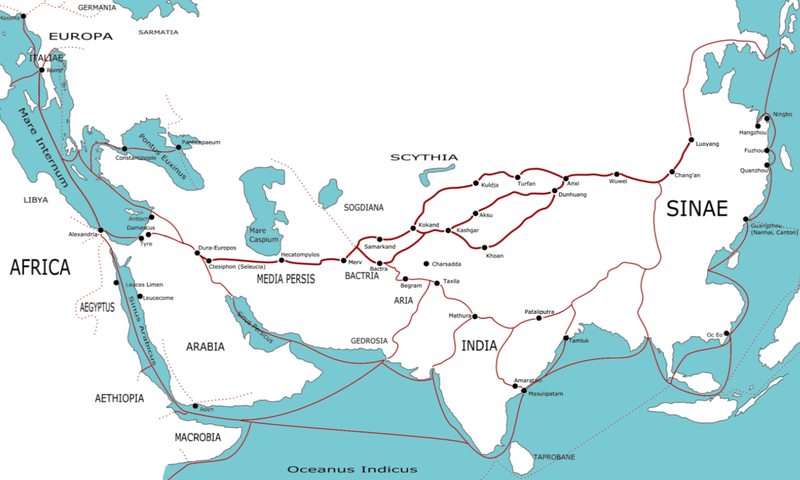
The large states of the time supported these routes, building roads, promoting communication, and patrolling the routes. But what kinds of items traveled these connections? From the name, it is clear that Silk very significant. Some cultures used it to wrap their dead in for burial. Others considered it very fine material for important religious occasions. Along with silk, spices were a popular commodity for trade. This included cloves, nutmeg from southeast Asia, and peppers from India. Cotton textiles, pearls, choral, and ivory also came from India. From the West, items such as horses were traded. The Romans sent things like glass, jewelery, pottery, wine, gold, and silver.
The Silk road did not function as you might imagine. What I mean is, people did not literally travel the road with various items to trade. Rather, the items were traded from merchant to merchant, over and over again. This is how they made it over the large area that the routes included. But it was not limited to just goods that were spread throughout the land. Even more impacting, ideas, cultures, and religion traveled it as well. Examples of the this are Christianity and Mahayana Buddhism. Imagine how significant this activity was in the development of the entire world of the day. What kinds of elements of your own life can you relate to this idea? Perhaps your religion? Or even the food you eat?
Thursday, October 22, 2009
In the Spotlight for AIDS is Sub-Saharan Africa
 AIDS Orphan Relief Effort
Thankfully, the world is responding. The two largest organizations are the Global Fund to Fight AIDS, Tuberculosis, and Malaria and PEPFAR, which is by the United States. PEPFAR has called for 15 billion dollars from the U.S. government to go towards AIDS relief, and therefore will greatly benefit sub-Saharan Africa. The funding works to prevent 12 million new HIV infections, provide care for 12 million already infected people, including 5 million orphans, and to train at least 140,000 health care workers.
This demonstrates America's support of sub-Saharan Africa. As a region in need, it is relying on countries such as the U.S. for help.
References:
HIV Insight.
http://hivinsite.ucsf.edu/global?page=cr09-00-00
Avert. Averting HIV and AIDS
http://www.avert.org/aids-africa-questions.htm
